I think I can safely say it’s spring now. Why, it hasn’t snowed in over a week!

The parsley, along with every one else, was ready for spring in mid-March. But winter had other plans.
We FINALLY tilled up 18,000 square feet of gardens yesterday, and planted the first of the peas and carrots. It’s all rather overwhelming, especially when you contemplate the vastness of the newly tilled fields, and the smallness of the rake, hoe, and wagon, which will be your only tools to maintain it for the next 8 months.

Don’t mind the pokeweed and pigweed remnants in the foreground. I try to think of them as cover crops in the fall. We need all the organic matter in the soil we can get!
We’re just a couple of steps away from having a fully operational hoop house, and only a few steps more than that to having a fence around the gardens that will at the very least slow down the myriad critters who have taken a strong liking to our crops.

Good thing OSHA wasn’t on site when we erected this thing!
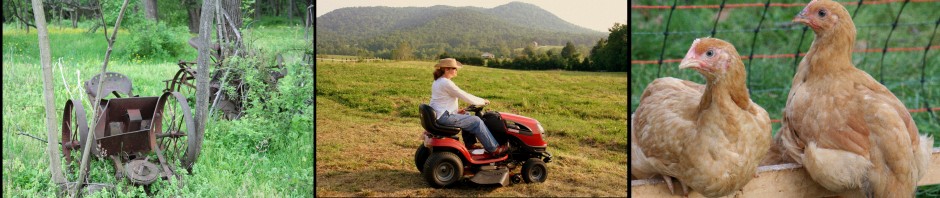
We’ve got a flock of 130 chickens on the field, and another 125 in the brooder. About 90% of the 750+ chickens we will be raising this year are already spoken for by customers. Our transplants are happily sprouting and leafing out in the heated greenhouses at Windmill Heights Garden Center, and the mower deck on our garden tractor will be repaired this week. (Repairing the mowing deck or some aspect of it is pretty much a regular occurrence here, due to my propensity for discovering boulders and forgotten pieces of lumber or hose in the tall grass while attempting to bushhog with our garden tractor.)

Shhh! They’re sleeping! We call this mass of fuzzy softness a “Chick Puddle.” Don’t step in it, though!
And then there’s this. A pile of what looks similar to pea gravel, and is in fact leftovers from a local quarry, sometimes known as “rock dust.” (It’s not a street drug, so please you crazy gen Y or Z kids or whatever, don’t snort this at home.)

Mini Thoroughfare Mountain just sprouted on our property.
I know. What in tarnation am I thinking getting gravel dumped on my garden? Or, as my neighbor put it when he saw me with my wheelbarrow at the pile, “I never know what kind of crazy you have going on over there.” See, he had just witnessed me spending the greater part of the winter–one time even in a snow storm–extracting rocks OUT of my gardens.
But if you think about it, you’ll realize it is actually a pile of cheap minerals which will activate the soil ecology. After all, what is rock but a whole lot of minerals waiting to be unleashed and taken up by the living things that need it for their very survival? And frugal farmers like my Uncle have been hitting up quarries for their leftover dust for darn near centuries. Mind you, he was more of a gardener than a farmer, and got the rock dust by the bucketful, which he put in the trunk of his Buick sedan. Me, I had a dumptruck deliver two tons of it. Yep, two tons. Now all that remains is to toss it around my fields, a bucket at a time.
Now, it’s not just me that’s throwing these minerals around around Madison County. A bunch of us ecologically-minded farmers attended a weekend workshop back in February put on by one of the founders of the Bionutrient Food Association. These people are drawing down on a plethora of soil science expertise in an attempt to get the word out about how to build the soil to get the nutrients back into our food supply.
Plants, and our bodies, need more than ratios of Nitrogen, Potassium, and Phosphate. While plants can survive on these elements (along with water and sunshine)–just like people can survive on french fries and soda pop, they won’t really be at their best. Far from it.
And did you know in the last 50 years, the amount of nutrition–that is vitamins and minerals–in our vegetables and fruits has actually been declining? As a 2011 article in Scientific American put it, “Modern intensive agricultural methods have stripped increasing amounts of nutrients from the soil in which the food we eat grows. Sadly, each successive generation of fast-growing, pest-resistant carrot is truly less good for you than the one before.”
In fact, our very brains are at risk. Is it just me, or did people used to be smarter? For a truly frightening and getting-ever-more-realistic scenario of our future if we don’t start eating (and living) right, and some laughs (and wincing for those who don’t appreciate swear words and off-color innuendo), I highly recommend the films “Idiocracy” and “Wall-E.” Prophetic visions galore. Shudder.

In a not-too-distant future scenario depicted in WALL-E, humans don’t even bother getting off their mobile loungers and are fed a steady diet of milkshakes and interactive media.
So a burgeoning group of us have this vision to get Madison County, Virginia on the map by making it a source of incredibly nutritious food. Food grown using techniques that build the soil, encourage beneficial microorganisms and insects, and don’t endanger human or soil health. We’re quietly spreading gravel-like substances into our fields, and getting ready to watch the plants thrive, and the pests go off and pester someone else’s weaker crop. We’re getting ready to watch the crop growth overtake the weed growth and make our life easier. We’re getting tools to measure the density of nutrients in our crops, and waiting for whiter teeth and fresher breath. Maybe one day we’ll even get a little bit smarter–and quit farming and move to the tropics.
In any case, I’m feeling enlightened from the workshop, giddy with the spring chore frenzy, and more dedicated than ever to being a steward of the soil and heck, even our community’s health. It got me thinking there should be some sort of Hippocratic oath for farmers. So I looked up the original for doctors, and amended it. The question is, whom shall we name it after?
I will follow that system of regimen which, according to my ability and judgment, I consider for the benefit of my plants, and abstain from whatever is deleterious and mischievous. I will give no deadly medicine to any plant, nor suggest any such counsel; and in like manner, I will not invest in plants that cannot produce viable seed. With purity and with holiness I will pass my life and practice my Art. Into whatever fields I enter, I will go into them for the benefit of the plants, and will abstain from every voluntary act of mischief and corruption, and further, from the seduction of pesticides or herbicides, of excessive tillage and monocropping.
In regards to soil and plant health, the Farmer must be able to tell the antecedents, know the present, and foretell the future – must mediate these things, and have two special objects in view with regard to malingering plants, namely, to do good or to do no harm. The art consists of three things: The soil, the plant, and the farmer. The farmer is the servant of the art, and the plant must work with the soil ecology along with the farmer.
This, I solemnly vow.





 The Clueless Farmer